
TL;DR
- An affiliate program pays you a commission for sending a customer to a merchant, tracked through a unique link and a cookie.
- Four players make it work: the merchant, the affiliate (that’s you), the network (sometimes), and the customer.
- Commissions come in a few flavors: pay-per-sale, pay-per-click, and pay-per-lead, each rewarding a different action.
- Payouts hinge on your commission rate, your earnings per click, and the average order value of whatever you’re promoting.
- You don’t need a website to get started. A social profile or a Beacons-style link page works too.
Somebody, somewhere, right now, is earning a commission because you clicked their link and bought a pair of trainers you didn’t strictly need.
That’s affiliate marketing in one sentence.
So how does an affiliate program work behind the scenes? Step by step, from the first tap to the money landing in your account, that’s what you’re about to find out.
I’ve been doing this since 1999, promoting digital products through MSN Groups and MySpace long before “affiliate marketing” was a phrase thrown around. These days the mechanics are far more transparent, and once you understand them, joining your first program stops feeling like guesswork.
Let’s get into the actual machinery.
What Is an Affiliate Program and How Does It Work?
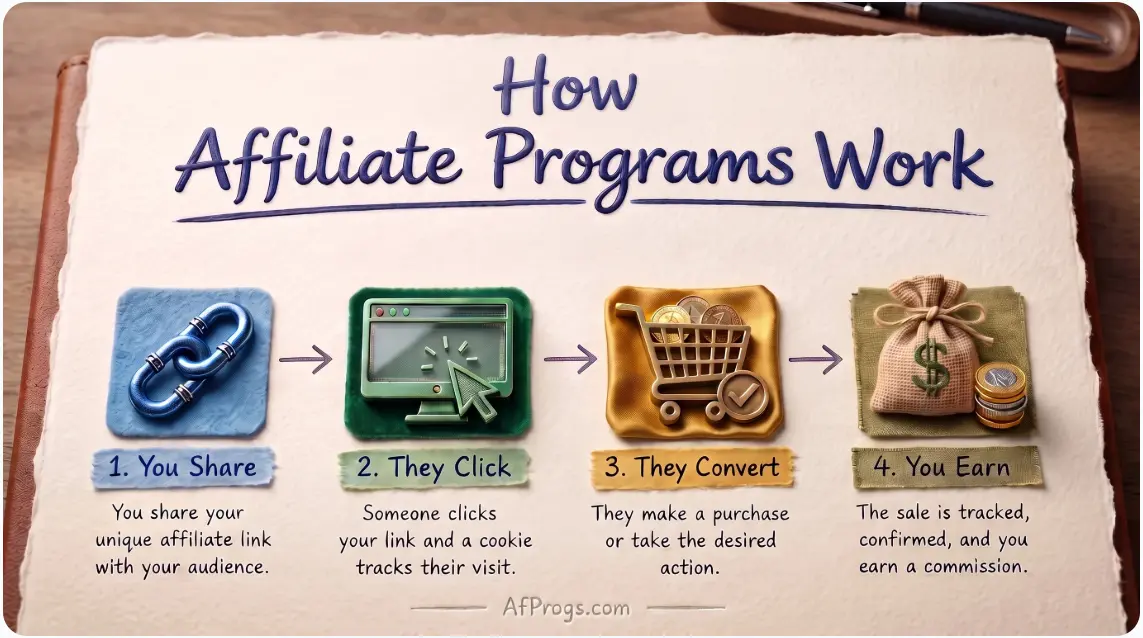
A merchant pays you a commission for referring a customer who buys, signs up, or takes some other action they’ve defined in advance.
You get a unique tracking link. You share that link (on a blog, a social post, a YouTube video, anywhere your audience hangs out). Someone clicks it, a small file called a cookie gets dropped on their browser, and if they complete the action the merchant wants within an agreed window, you get paid.
That’s the whole loop.
Click, track, convert, commission.
The Federal Trade Commission’s own consumer-facing breakdown puts it just as plainly: click an ad, and everyone gets paid behind the scenes, the merchant who owns the product, the network that connects merchant to marketer, and the marketer (you) who made the introduction.
Nobody pays you for showing up.
You get paid for results.
Who Is Involved in an Affiliate Program?
Four people, each with a job: a merchant selling something, a marketer promoting it (you), a network tracking the sale behind the scenes, and a customer who buys.
Merchants own the product or service and fund the commissions. Your job as the affiliate is creating content, reviews, or recommendations that point people toward that merchant.
Networks, when one’s in play, sit in the middle handling tracking, reporting, and payments, so the merchant and affiliate don’t have to build all that plumbing themselves. And the customer? They’re the one who sets the whole chain off with a single click and a purchase, usually without a clue any of this is happening behind the curtain.
Mind you, plenty of programs skip the middleman entirely. Some merchants run their own in-house tracking (Wealthy Affiliate is one I use myself), which usually means simpler dashboards and fewer hands in the pot taking a cut.
The FTC is blunt about the trust involved too: affiliate marketing is a legitimate way to promote a product, but only when the promotion is honest and the misleading ads don’t creep in. That’s your disclosure requirement in a nutshell: say you’ll “earn a commission”, plainly, every time.
How Do Affiliate Partnerships Work in Practice?
Theory’s fine, but let me show you what this looked like the first time it worked for me.
Back in September 2011, I built a Squidoo lens (a now-dead content platform, RIP) around one keyword: “cheap plus size halloween costumes.” Nothing clever, just a handful of basic SEO lessons from an old auto-blogging course, promoting Halloween outfits through the BuyCostumes.com program on Commission Junction.
On October 3, 2011, that lens hit position one on Google’s first page for the exact keyword I’d targeted. By the 24th, I’d banked £70-plus in commissions, with impressions, clicks, and sales rolling in daily right up until Halloween itself.
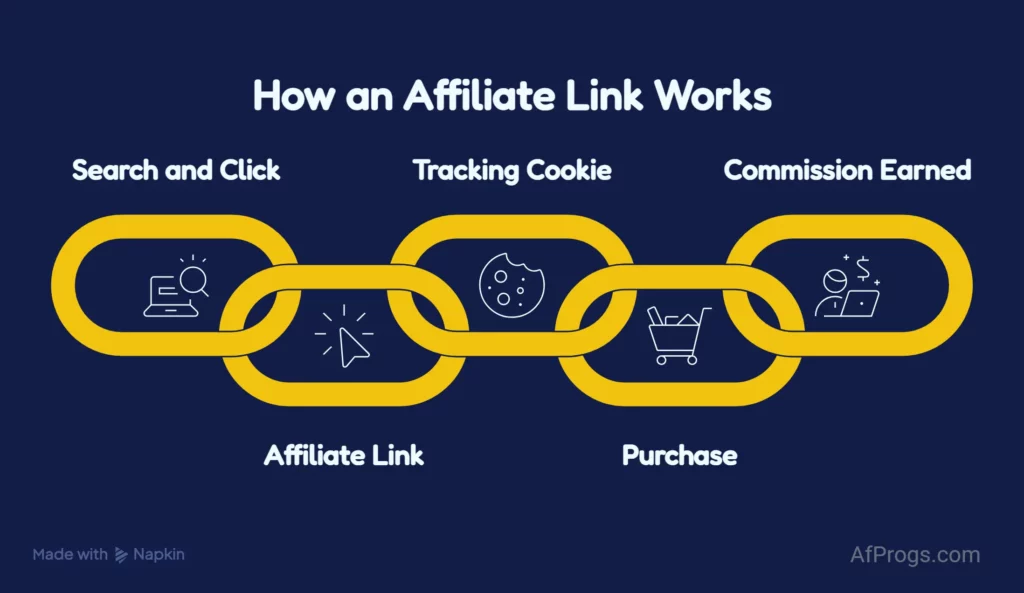
Here’s the mechanism behind that win, spelled out step by step:
- Someone searched for the keyword and clicked my page in Google’s results.
- They clicked my BuyCostumes affiliate link from inside my content.
- A tracking cookie landed on their browser, carrying my affiliate ID.
- They bought a costume within the cookie’s active window.
- Commission Junction matched the sale to my ID and credited my account.
Five steps.
No wizard magic, just tracking doing exactly what it’s built to do.
Worth noting: that result reflects my own individual experience from over a decade ago, not a typical or guaranteed outcome for anyone starting out today.
How Do Affiliate Programs Generate Income?
Through commissions. The merchant hands over a slice of the sale, or a flat fee per lead, only once the result they wanted happens. You get that cut for making the introduction.
Everybody’s incentives point the same direction.
That’s the entire appeal for merchants over traditional advertising.
A billboard costs the same whether it sells one car or none. With an affiliate program, the merchant only pays out once a sale actually happens.
It’s also why the channel keeps growing instead of shrinking. Brands would rather pay for a result they can point to than gamble on an untracked ad, and the 2028 forecast numbers back that shift up.
For you, it comes down to volume and relevance. Point the right people at the right offer and a small slice of each sale stacks up fast across a few hundred clicks.
Send the wrong people, and you’re just generating clicks nobody pays for.
What’s the Difference Between Affiliate Networks and Individual Programs?
One’s a shared marketplace hosting thousands of brands under a single login. The other’s a straight line to one brand’s own dashboard. Worth knowing which you’re dealing with before you sign up.
Awin puts it plainly: a performance-based relationship, where advertisers only pay when something happens, a sale, a lead, or a click, whatever they’ve agreed to reward. No result, no payout.
Networks like Awin, CJ Affiliate, and Impact hand you one login for dozens of brands, shared reporting, and a bigger library of banners and feeds than you’d build yourself. Individual programs trade that convenience for a closer relationship with the brand, and sometimes a better rate, since nobody’s skimming a cut before it reaches you.
Take the Beacons program as an example of a direct, individual program. No network sits between you and the brand: you sign up, get your link, and start promoting straight away.
Pick based on what matters more to you, convenience or payout. Networks win on the first, individual programs sometimes win on the second.
How Do Affiliate Commissions Work?
One of three actions: a sale, a click, or a lead. Which one applies depends entirely on the program.
Pay-per-sale (PPS) is the one you’ll run into most. No sale, no payday, simple as that. Once the customer buys, your commission is usually a straight percentage of the order.
Pay-per-lead (PPL) pays out for a specific action instead: a form filled in, a free trial started, a newsletter signed up to, whether or not that person ever buys a thing. Awin classifies this as cost per lead, a fixed fee every time a qualified lead lands.
Pay-per-click (PPC) is the rare one, and I’m not sad about it. You get paid just for sending traffic, buyers and window-shoppers alike, which is a bit like a shop paying you for everyone who walks past the door. Most programs won’t sign up for that, and you can see why.
In my book, pay-per-sale and pay-per-lead cover most of what you’ll promote as a beginner. Master those two before you go chasing anything more exotic.
How Are Affiliate Payouts Calculated?
Take your commission rate and multiply it by whatever the triggering action is worth, a full sale or a flat lead fee. That’s your payout in a nutshell.
Now, two numbers matter more than any others, and you ignore them at your peril: earnings per click (EPC) and average order value (AOV).
EPC tells you what a single click into a program is worth, on average. Divide total commissions by total clicks and there’s your number, and most programs show it right there in your dashboard so you can size up offers at a glance.
PartnerStack describes it as earnings per click, the metric affiliates rely on most when deciding which program deserves their promotional effort.
AOV is simpler: the average dollar amount a customer spends per order. A ten percent commission on a $200 average order beats a twenty percent commission on a $20 one, every time. Do that math before you assume a higher percentage automatically means more money, because it usually doesn’t.
My own quick filter: if the EPC sits under a dollar and the AOV’s under fifty, I pass, no matter how tempting the commission percentage looks on the page.
Want to run these numbers on a program you’re considering before committing your content to it? My commission calculator does the math across five different billing structures so you’re not guessing.
How Cookies and Tracking Links Attribute Every Sale
A cookie is a small text file dropped on a customer’s browser the moment they click your affiliate link, and it’s what tells the merchant’s system the sale belongs to you.
Think “Neil sent me” scribbled on the shopper’s forehead in invisible ink. They can’t see it, but the merchant’s checkout can, and that’s how you get paid.
Every cookie carries your unique ID, a timestamp, and an expiry date. As long as your customer buys before that clock runs out, the sale’s credited to you, even if they browsed for three days first and wandered back in through a totally different search.
Tracking windows vary wildly by program. Some run 24 hours. Others stretch to 30, 60, or even 90 days.
Amazon Associates runs one of the shortest windows in the industry, a 24-hour cookie, but with a clever catch. If a shopper drops an item into their cart that first day, you still get credited when they buy it, right up until the cart itself expires, which Amazon puts at around 90 days.
That’s why longer tracking windows matter more than beginners usually assume.
A short one punishes anyone whose audience needs a few days to decide. A longer one rewards patience, both yours and theirs.
How Do Affiliate Programs Pay You?
On a set schedule, usually monthly, once you’ve cleared a minimum payout threshold. Nobody’s wiring you money the second a sale happens, so don’t sit refreshing your dashboard.
Common thresholds sit anywhere between $25 and $100, though some direct programs pay whatever you’ve earned, no minimum in sight. Bank transfer and PayPal cover most of it, and yes, a few still post a paper check, because nothing says “modern side income” like waiting by the mailbox.
Here’s the part that catches new affiliates off guard: most programs hold your commission in a “pending” state before releasing it, giving the merchant time to account for refunds or cancelled orders. My own Wealthy Affiliate yearly commissions sit in that pending state for 30 days before they’re released, and I still breathe a little easier every time one clears.
Don’t panic if a sale shows up as pending rather than paid. That’s completely normal, and it clears on its own once the holding period passes.
How Does an Affiliate Program Work in 2026?
The core mechanics (link, click, cookie, commission) haven’t changed. What’s shifted is who’s earning and how they’re getting found.
US affiliate marketing spend is projected to hit $13.81 billion in 2026, up 11.3% from the year before, and that channel is now expected to influence roughly $241 billion in 2026 spend forecast US ecommerce sales this year alone.
This isn’t a niche side hustle anymore. It’s infrastructure.
Creators and influencers are the fastest-growing slice of that spend, pulling budget away from the old coupon-and-cashback sites. Brands would rather back a real person than a discount code box.
AI search tools are pulling straight from affiliate content now too, and they favor write-ups with real experience behind them. That’s the one thing thin, generic content can never fake.
Translation: 2026 rewards affiliates with genuine proof over affiliates with polished templates.
Do You Have to Have a Website to Join an Affiliate Program?
No. Plenty of affiliate programs approve creators who only operate on social media, with no website required at all.
Blogs and review sites still pull a solid chunk of the spend, but plenty of merchants will happily approve you with no website at all, just a social account. A link-in-bio page, a TikTok profile, or a YouTube channel will get you waved through on most programs just as easily as a domain would.
Still, a website hands you something no social platform can: content that can keep ranking and earning years after you hit publish, with no algorithm deciding whether anyone sees it today.
If you’re weighing up which route fits you, my Start Here guide walks through both paths, website or social first, so you can pick the one that matches how you already like to create.
Steps to Join an Affiliate Program
- Pick one program that fits an audience you understand. Not ten. One. I’ve laid out my full framework for picking a program if you want the details.
- Read the terms before you apply. Cookie duration, commission rate, and payout threshold should all be visible before you sign up.
- Fill in the application. Most ask for your website URL or social handle, expected promotional method, and sometimes your existing audience size.
- Wait for approval. Some programs approve instantly. Others take a few days for a real person to review your application.
- Grab your unique tracking link from the dashboard. Only that one gets you credit for sales.
- Create content that genuinely helps someone decide, not just content stuffed with your link for the sake of it.
- Check your dashboard regularly to see what’s converting and what’s dead weight.
I promoted Russell Brunson’s free Perfect Webinar script as a ClickFunnels affiliate starting in 2017, letting that single free entry point upsell into backend products and subscriptions on its own. Within the first year that turned into $6,000-plus in commissions.
That result reflects my own documented history and isn’t typical or guaranteed for anyone joining a program today. But it’s proof the mechanics work exactly the way I’ve just laid them out, as long as you follow through
You can read more about how I got there, and what 25-plus years in this game has taught me, on my About Neil page.
Bringing It All Together
Every affiliate program you’ll ever join runs on the same four moving parts: a merchant, a link, a cookie, and a commission structure calling the shots on what gets paid and when.
Once you can spot those four things inside any program’s terms page, you’re no longer guessing whether a program is worth your time.
You’re reading it the way an affiliate who understands the mechanics does.
That’s your edge.
Ready to put this into practice? Browse my blog archive for program-by-program breakdowns,
Your ‘still-figuring-out-the-cookie-window’ partner, Neil.