

TL;DR
- Beginners: stick to one program until it’s earning steadily, then add two or three.
- Programs drop you for low or no sales, so spreading thin can backfire in more ways than one.
- Running more than one program protects you if a program changes its terms overnight.
- Quality beats quantity every time. A handful of well-matched programs will out-earn a scattered pile of them.
- The right number depends on your time, your niche, and how deep you can go with each program.
Every beginner affiliate hits the same wall eventually. You join one program, it’s going fine, and then you spot ten more that look shinier.
So you sign up for all of them… a bit like piling up your plate at an all-you-can-eat Chinese buffet, as if your life depends on it.
Exciting for about five minutes, then half of it’s stone cold before you’ve even made a dent in the rest.
And that’s usually where the trouble starts.
I’ve been doing this since 1999, and I’ve made that exact mistake myself. More than once.
Every affiliate program is an opportunity, but not all of them deserve your time in month one.
So let’s settle this the right way: how many affiliate programs should you join, and how do you know when it’s time to add another one?
If you want the wider picture beyond this one question, my affiliate marketing guides cover the rest of the roadmap.
How Many Affiliate Programs Should I Join as a Beginner?
One. That’s the number I’d tell any beginner to start with, then two or three more once that first program is earning something real.
Here’s why that feels too slow for most people, and why it isn’t: when you’re new, you don’t yet know which products your audience buys, what content format converts, or how long a program’s cookie window really needs to be before it pays off.
One program lets you learn all of that without the added chaos of juggling five affiliate dashboards at once: separate logins to remember, reporting quirks that don’t match up, and no shared definition of what counts as a “sale.”
This isn’t multitasking. This is plate-spinning while riding a unicycle.
When your first program is bringing in consistent commissions, and you’ve got a content system that doesn’t fall apart the moment you add something new, it’s your signal to grow. Here’s how the number tends to change with experience:
| Experience Level | Programs to Run | What You’re Building |
|---|---|---|
| Beginner | 1–3 | Product knowledge, one steady content system, real earnings data |
| Intermediate | 3–7 | Income spread across seasons, room to test new commission structures |
| Advanced | 8–15+ | A managed portfolio, usually with tracking systems and help |
Notice that even at the advanced end, nobody’s pretending there’s no ceiling. There’s always a ceiling. It just moves as your systems get better.
Why Should I Join Multiple Affiliate Programs?
It protects your income, and it gives you more than one product to recommend, no matter which platform you’re posting on.
Programs change their payout percentage whenever they decide to, and they don’t call you first.
In April 2020, Amazon’s overnight cut did exactly that, dropping some categories from 8% down to 3% within a week of the announcement.
Should that program have been someone’s entire income, it was a bumpy month with no backup plan.
Giving your audience more to work with is the second reason. One program means the same recommendation shows up in every post or video regardless of fit.
Two or three programs let you match the right one to the platform, the audience, or the specific piece of content you’re creating.
If you run a website, there’s a bonus here too. Google’s guidance for writing reviews notes that linking to more than one seller can make a review more useful in practice, since it gives readers options instead of one obviously self-interested link.
Neither reason means you need ten programs on day one, that’s the buffet plate all over again. It means one program is fragile, and two or three is where things start to feel a lot steadier.
Worth a browse through the blog if you want to see what a second or third program might look like for your niche.
What Happened When I Joined Too Many Programs at Once
Not my finest moment, but here it is.
I got greedy. I signed up for a small handful of programs all at once, convinced that more options meant more money… In practice, it fell apart fast.
First problem: time. Managing a handful of programs at once meant logging into just as many separate dashboards: different tracking link formats, mismatched reporting, and logins I’d inevitably forget.
What should’ve been ten minutes of checking earnings turned into an hour of admin most days, less like running a business and more like a class talk where everyone else ghosted.
Second problem: earnings. Because I was only promoting a few products from each program across my site, every single one brought in a trickle rather than a real income stream.
Nothing added up to anything worth the time it took to manage it.
Third problem, and this one stung: I got dropped. Some of those programs removed me for making little to no sales.
At the time it felt harsh, looking into it since, it’s just standard policy.
Plenty of brands write a zero-sales removal clause straight into their affiliate program terms. It’s routine, not a punishment aimed at you specifically.
A near-identical rule removes affiliates after roughly six months of no sales, according to Newspapers.com’s affiliate terms. I wasn’t unlucky. I was spread too thin, and the programs noticed before I did. That’s the version of ‘join more programs’ nobody warns you about.
If you’d rather skip that lesson entirely and build things the right way from the start, my Start Here page shows you exactly how I vet programs before I ever recommend one.
What Is the Impact of Joining Too Many Affiliate Programs?
Diluted content, thin earnings per program, and a real risk of getting removed for low performance, all at once.
You can’t go deep on ten products the way you can on two or three, and hope your audience doesn’t notice.
Generic, watered-down content converts worse than the kind of detailed, lived-in recommendation you can only give about something you use yourself.
Earnings work the same way. A trickle from ten programs rarely beats a solid stream from three.
There’s also the admin nobody budgets for. Plenty of these programs run through a bigger affiliate network behind the scenes, and each one has its own separate reporting portal, real-time, but only for that platform.
Same story everywhere, and Awin’s FAQs confirm it. Nobody hands you one master view of your earnings.
You build it yourself, in a spreadsheet or a tracking tool, or you go without.
Add enough programs and you’re running a part-time job just resetting passwords instead of promoting anything.
Should I Focus on Quality or Quantity of Affiliate Programs?
Quality, every time. A handful of programs that fit your audience will out-earn a long list of programs that merely exist.
Here’s a simple way to think about it: a program with strong earnings per click, decent commissions, and genuine relevance to your niche will beat five random sign-ups combined, because your audience trusts the recommendation.
Quantity gives you options. Quality gives you conversions.
Your audience can tell the difference between a program you understand and one you’re promoting because it showed up in your inbox.
What Are the Key Factors in Choosing Multiple Affiliate Programs?
Niche fit, commission structure, your available time, and how much overlap there is between programs.
First up is whether a program makes real sense next to everything else you’re already promoting, and creator-focused programs are the clearest example, since they only work if your content already fits that mold.
Take the Beacons affiliate program. It fits a link-in-bio or content creator audience perfectly, but it would feel out of place on a finance-focused blog or page.
Commission structure comes next. Look at the actual commission rate, whether it’s one-time or recurring, and the tracking window you’re working with, since a short one punishes anyone whose audience takes time to decide.
Average order value matters more than people expect. Low basket values mean you need serious volume to add up to anything, while a higher one doesn’t.
Direct, in-house programs and ones run through an affiliate network offer different levels of support.
Networks tend to centralize your affiliate link and reporting in one place, and often come with a bigger library of banners and product feeds, so you’re not building everything from scratch yourself.
Finally, check you’re not stacking two programs that compete for the exact same click. If two programs are fighting over the same recommendation, you’re not diversifying, you’re just splitting one opportunity in half.
How Do I Know if I Should Join More Affiliate Programs?
When your current program earns consistently, your content routine has room to spare, and you understand its joining requirements well enough to clear them without guessing.
That first part matters because it proves the model works, not just that one lucky month you had.
Spare capacity means you can create quality content for a second program without your first one slipping.
And knowing the approval process (some are instant, some want an established site or a minimum audience size) means you won’t waste time applying to a program you’re not ready for yet.
How Do I Know if I Joined Too Many Affiliate Programs?
You can’t keep content updated across every program, you’ve lost track of which one pays what and when, and logging into your affiliate dashboards feels less like a five-minute check-in and more like translating hieroglyphics before your morning coffee’s kicked in.
Another sign: you stop opening emails from your affiliate managers because you can’t keep track of who’s who anymore.
If you miss a bonus commission week because you found out three days late, that’s not bad luck, that’s too many programs and not enough attention to go around. None of this is a small detail to shrug off. It’s a sign you’ve got more programs than you have a system for.
Can I Succeed in Affiliate Marketing With Just a Few Programs?
Yes. Some of my steadiest years came from a select few programs I knew inside out, not a sprawling list I barely kept up with.
Depth beats breadth any day of the week.
Understanding a product well enough to answer any question your audience might have, and to create content that really helps them decide, will out-earn a scattergun approach every time. Fewer programs, done right, is a complete strategy on its own. It isn’t a consolation prize for not having more.
Strategies for Balancing Multiple Affiliate Programs
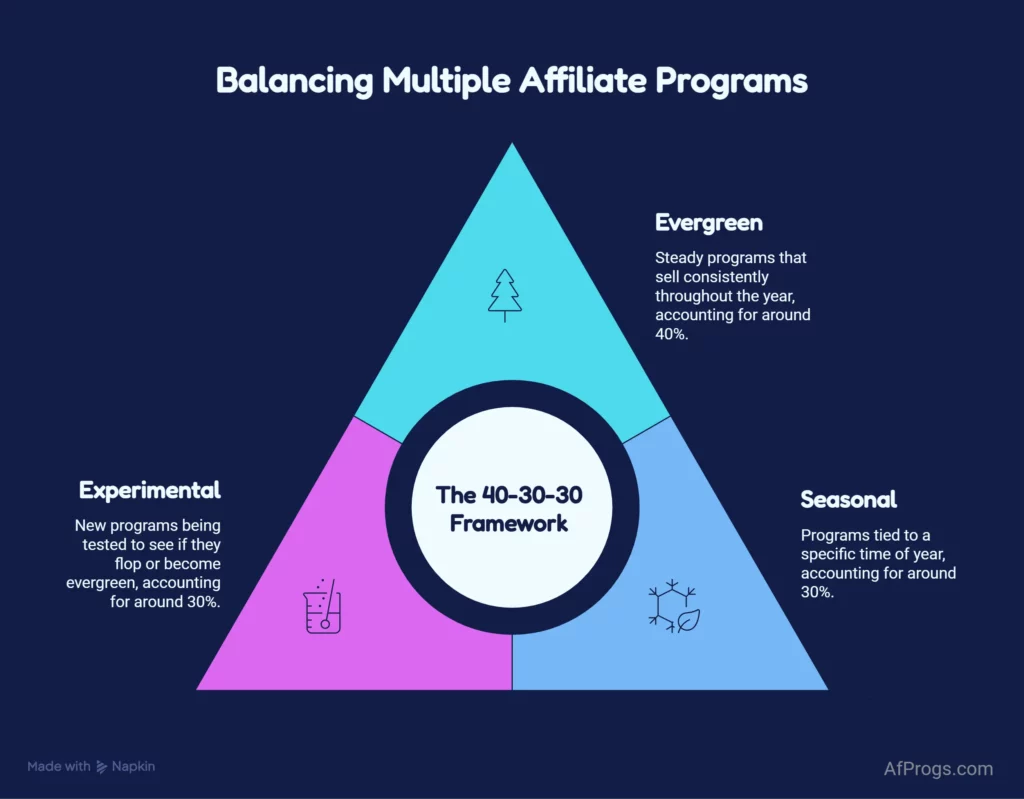
Once you’ve got more than one program running, the way to balance them without losing your marbles is to think in three buckets rather than one long list.
I’ve relied on a version of this split for years:
- Evergreen (around 40%): your steady programs, the ones that sell just as well in March as they do in November. These carry the year.
- Seasonal (around 30%): programs tied to a specific time of year. Think adult Star Wars Halloween costumes or artificial Christmas trees, they show up hard for a number of weeks and go quiet the rest of the time.
- Experimental (around 30%): new programs you’re testing. Some will flop. Others will become tomorrow’s evergreen pick. You won’t know until you try.
On the practical side, a few habits make the real difference between managing this well and drowning in it:
Track earnings per program in one place. Even a simple spreadsheet beats relying on memory across five different dashboards. If you want a quicker way to see how a program’s payout structure adds up over a year, my commission calculator does the math for you.
Batch your content by program. Switching between five different offers in one sitting kills your focus. Dedicate blocks of time to one program at a time instead.
Review quarterly, not never. Every three months, look at what’s earning and what’s just collecting dust. Payout timing shifts, terms change, and a program that was working wonders last year might not be worth the shelf space anymore.
Which Number Fits You? Take the Quick Quiz
Everything above gives you the reasoning.
If you’d rather skip straight to a program number, answer these three quick questions.
Affiliate Program Readiness Check
Three quick questions. Get your starting number.
How long have you been creating content for your site or channel?
Conclusion: Fewer Programs, Done Right, Wins
How many affiliate programs should you join? Start with one. Prove it works.
Add two or three more once it's actually earning, and let your niche, your time, and your systems decide how far past that you go.
I've seen this play out the same way more times than I can count on both hands (and feet!), including in my own business.
The affiliates spreading themselves across a dozen half-managed programs rarely out-earn the ones who went deep on three or four that fit their audience.
Quality always wins, no contest.
Not sure yet which lane fits you best, website, social, or starting from scratch? Take the quiz and I'll show you where to start.
That's the final tally. Your 'still-counting-on-one-hand' partner, Neil.

I agree with you that as tempting as it is, joining too many different affiliate programs does tend to spread you thin, and it is better to master a few of them than only make random sales on some of them. Trying to do the admin required with joining too many programs is also very time consuming.
I tend to stick with the ones that have been around a long time like Amazon, although their commissions are low, it is easier to sell on a well known platform that everyone knows and trusts than something that people haven’t heard about before. On the other hand you do also need to be careful of putting all your eggs in one basket as you said, so I try to use 4 to 5 at the most.
Yep, there are definitely numerous downsides to greed in the affiliate marketing world. We all learn that lesson sooner or later (haha).
I agree on Amazon too. Even if the commissions percentages are small in some categories, if you sell enough volume, you’re on to a winner. Plus, folks always buy extra stuff on Amazon, which you’ll get credited for as well. I remember earning from an $800 sewing machine sale ON TOP of the artificial Christmas tree a customer once bought through my link once. So Amazon can be worth it!
At the end of the day, if folks don’t bite off more than they can chew (according to their affiliate marketing experience/level) and are also more “selective” with their program choices, there’s a great deal of income to be earned online.
This post delivers exactly what aspiring and experienced affiliate marketers need—practical, experience-backed guidance without the fluff. Your breakdown by experience level is spot-on.
As a beginner, I can relate to the temptation of joining too many programs too soon. The “less is more” approach really resonated, especially the part about scattered content and poor conversions. I also appreciate the reminder that your time and systems dictate what’s realistic—not some magic number.
The analogy of affiliate programs being like adopting puppies made me laugh (and hit home). For intermediate and advanced marketers, the insights into portfolio diversification and prioritizing high-commission, low-maintenance programs are excellent.
If you’re wondering how many affiliate programs to join, this guide will save you from burnout and set you on the right path.
I appreciate the complement Andres! 🙂
I’m glad you gained plenty of value from my article and enjoyed the ‘LOL moments’, hopefully it will help affiliates (newbies especially) to overcome some of the actual money-making obstacles they face in their businesses.
This makes it easier for me to plan and strategize moving forward. I didn’t realize the right number of programs was 1-15 for novice to advanced affiliates. I agree finding the right balance is essential given one’s current circumstances. Considering time, audience, and commission makes the decision easier to make. Thanks for sharing your diversification framework. I agree that quality outranks quantity every time. So much good info here.
So glad to hear it, Joseph! There is no “one size fits all” when it comes to joining programs and affiliate marketing in general.
Also life gets in the way for us all, which is another important factor to bear in mind when working to build a profitable online business. So it really is a balancing act for folks.
You’re very welcome!