


TL;DR
- The right affiliate program fits your niche and audience first. The commission rate is a secondary concern, not the deciding one.
- Beginners are better off starting with one program they understand well, not five they’re hoping will work out.
- Commission rate, cookie duration, and payout options all matter, but only after you’ve confirmed the program is trustworthy.
- My personal criteria (25%+ commissions, 60+ day cookies, recurring structure) works for my digital marketing niche. Yours will likely look completely different if you sell physical products.
- Review your programs every few months. Picking right isn’t a one-and-done decision, it’s a habit.
Everyone tells you to “join an affiliate program” like that’s the whole plan. Pick one, slap the affiliate link on your site, watch the commissions roll in. It’s a bit like buying a gym membership in January and assuming the abs sort themselves out.
Nobody explains how to choose the right one though, and that’s usually where beginners get stuck before they’ve even promoted a single product.
I’ve been doing this since 1999, and I’ve joined more affiliate programs than I care to admit. Some were brilliant. Some were a genuine waste of a Tuesday afternoon.
The difference rarely came down to luck. It came down to whether I’d thought it through before signing up.
What follows is exactly how to pick the right affiliate program for your niche, from total beginner to just tired of guessing. If you haven’t settled on your lane yet, my start here guide covers building a website versus going the social media route first.
Why Is It Important to Select the Right Affiliate Program?
Picking the wrong program costs you months of content, traffic, and trust you can’t easily win back.
Every post, video, or caption you create around a program is an investment. If it doesn’t convert, pays badly, or gets shut down without warning, you’ve spent real time promoting something that never had a shot.
Worse, if the product turns out to be low quality, your audience remembers who recommended it.
That’s you.
And affiliate marketing isn’t a small corner of the internet either. Brand investment in the affiliate channel keeps climbing, with spend projected to push toward $35.4 billion over the next several years.
More money in the channel means more programs competing for your attention, and more reasons to slow down and pick carefully instead of joining the first one that hits your inbox.
To thrive in affiliate marketing today, you need genuine experience in your niche and the ability to show it.
Faking it till you make it stopped working a long time ago, for you and for Google.
How Do I Choose the Right Affiliate Program for My Niche?
Match the product type to what your audience already wants, not whichever program pays the highest commission.
Start with the product type. If your audience is into affiliate marketing and making money online, digital products (courses, software, communities) usually fit better than physical goods.
If your content covers hiking gear or home decor, the opposite is true. There’s no universal answer here. A program can be perfect for one niche and a complete mismatch in another.
The programs themselves check for this fit on their end too. Awin’s own advice to new publishers starts with working out their audience needs before anything else.
If you can’t answer that for your own following, no commission rate will save a program that doesn’t belong on your site.
Content format is the other piece of the puzzle. A program built for bloggers with long-form reviews won’t necessarily suit a creator posting short-form video, and vice versa.
And before assuming it’ll work for your format, check what promo materials a program provides. Ready-made creatives save you a lot of design time, especially early on.
How Do I Pick the Right Affiliate Program as a Beginner?
One program is where to begin: understand it well, get it earning something real, then add a second.
When you’re new, you don’t yet know which products your audience buys, what content converts, or how long a program’s cookie duration needs to be before it pays off.
Keeping to a single offer means your full attention goes toward figuring all that out, instead of getting split across a stack of dashboards and password resets.
Look for programs with a low barrier to entry while you’re finding your feet. Plenty of established software programs are upfront that there’s no minimum sales requirement to start earning, which takes the pressure off while you learn.
Don’t confuse “beginner-friendly” with “beginner-only.” A program that’s easy to start with will still be earning for you years down the line.
What Are the Key Factors to Consider When Choosing an Affiliate Program?
Commission rate and structure, cookie duration, product quality and demand, and the level of support behind the program all decide whether it’s worth your time.
Getting credit for a sale after someone clicks your link depends on the tracking window. Industry standards run anywhere from a day to 90 days, with a 30-day window treated as the rough baseline.
Some programs stretch further. A handful offer lifetime cookies, rare enough that finding one feels like spotting a parking space right outside the shop.
Commission structure carries just as much weight as the rate itself. A one-off payment and a recurring commission on the same percentage are not the same opportunity, since one pays a single time while the other keeps paying long after you’ve forgotten you ever shared the link.
Recurring structures let your earnings stack instead of resetting every month, which is exactly why some established programs lead with it.
HubSpot’s own program publishes its terms openly: a 30% recurring commission for up to a year on referred subscriptions, with no minimum sales required to get started. That kind of transparency is a great sign.
In my experience, once I started weighing programs against a personal checklist instead of jumping on whichever one was hyped the loudest, everything changed. Here’s what I look for on the money side, specific to promoting digital training and software programs:
- A 60 to 90 day cookie duration at minimum, lifetime cookie if I can get it
- Commission rates of 25% or higher
- Monthly and yearly recurring commissions, so earnings compound instead of resetting
- High quality products that are fairly priced and genuinely in demand
- A value ladder of upsells, something I learned from Russell Brunson’s DotCom Secrets book, where one sale opens the door to several more
- Solid, responsive support from the program itself
- A decent stash of promo materials, so I’m not designing banners from scratch
- The mom test: if I wouldn’t recommend a program’s products to my own mom, I don’t recommend them to you either
That list is built for my corner of affiliate marketing: digital training platforms, software, and membership communities. If you’re promoting physical products, your numbers will look nothing like mine, and that’s completely fine. A homeware program running a 5% commission and a 24-hour cookie can still be worth your time if the average order value is high and the audience converts well. There’s no single scorecard that works for every affiliate in every niche.
Average earnings per click deserves a glance too, if the network shows it for a program. It won’t tell you the whole story, but a consistently low EPC means plenty of affiliates have already tried and struggled to make it pay.
Want to see how a recurring commission compares to a one-off payment over a full year? My commission calculator does the math for you.
How Do I Identify a Trustworthy Affiliate Program?
Transparency is the giveaway: clear terms, free to join, and open about how and when it pays.
Legitimate programs don’t charge you a cent to join. If a “program” wants payment before you’re allowed to start promoting, walk away, that’s a seller looking for customers, not partners.
Watch for unrealistic earnings claims. If a program promises five-figure weeks with zero experience needed, that’s the calling card of a scam, not a serious business partner.
Real income takes real work, and any program that tells you otherwise is selling you a pipe dream before you’ve even signed up.
Disclosure belongs on your checklist too. The FTC’s own guidance defines a material connection as any payment, free product, or commission tied to your recommendation.
That’s exactly why every program worth joining expects you to disclose that relationship rather than hide it. One that discourages you from disclosing is actively asking you to break the law on its behalf.
I lay out exactly how I handle this on my own affiliate disclosure page, worth a read if you want a working example to model your own on.
Even the major networks build compliance readiness into how they vet new brands before letting them onto the platform.
If a network that size takes it seriously before onboarding an advertiser, you can afford five minutes checking the terms page before you onboard yourself.
AfProgs vets every partner listed here for legitimacy too. No gambling programs, no lender programs, nothing that wouldn’t pass my own mom test.
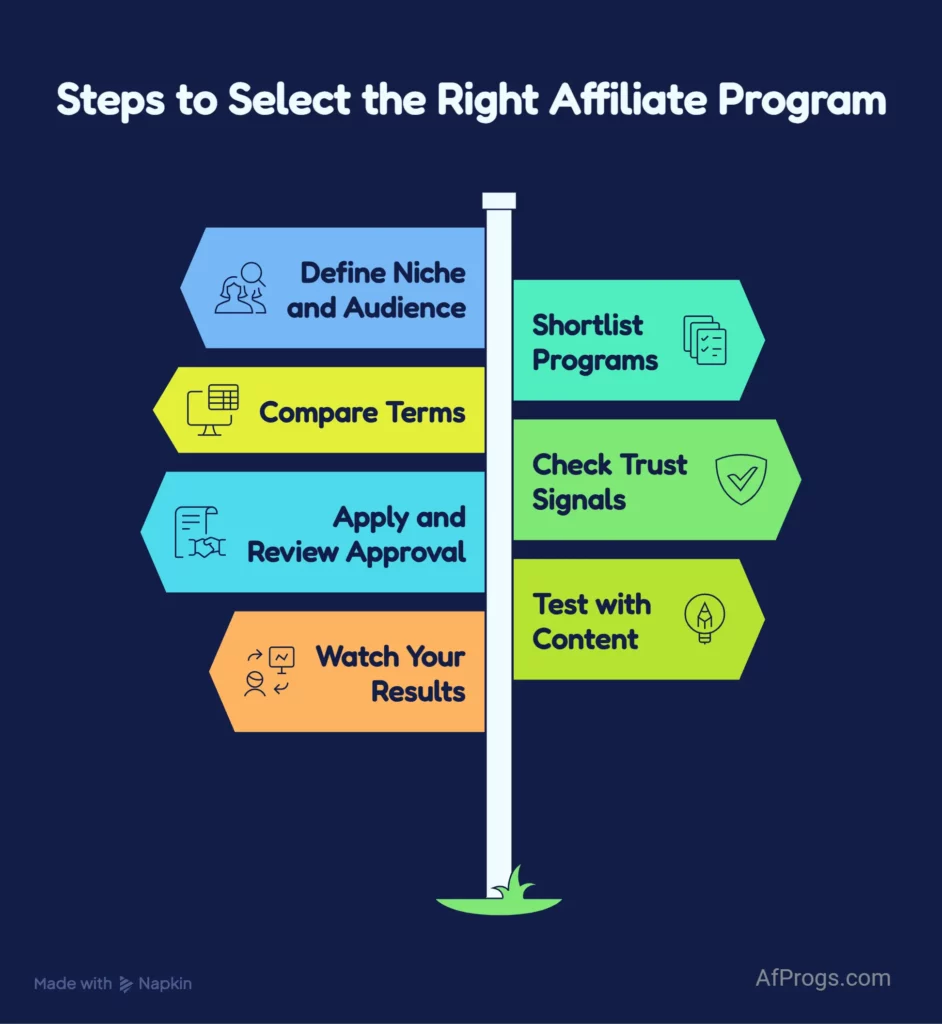
Steps to Select the Right Affiliate Program
Once you know what to look for, the selection process itself is a short, repeatable checklist:
- Get clear on your niche and audience first. Don’t look at a single program until you know who you’re talking to.
- Shortlist three to five programs that genuinely fit what your audience already wants, not whatever landed in your inbox this week.
- Compare the terms side by side. Commission rate, cookie duration, payout options, and payment schedule all belong on the same spreadsheet.
- Look for trust signals. Transparent terms, no upfront fees, and real contact details, not just a contact form that goes nowhere.
- Apply and see what application approval involves. Some programs approve instantly. Others want an established audience first. Both are normal.
- Test it with real content before deciding whether to go all in with your time and energy.
- Watch your results through your affiliate dashboard for a few weeks, then decide whether to scale up or move on.
Can I Join Multiple Affiliate Programs at Once?
Yes, nothing stops you from running more than one at a time. Just don’t make that your starting point.
Starting with one means you build real depth on a single product before splitting your attention.
I’ve written a full breakdown of how many affiliate programs you should run at once, including what happened when I joined too many too fast myself. Worth a read before you go shopping for program number four.
When Should I Review My Affiliate Program Strategy?
Every three months is a sensible checkpoint, or sooner if a program changes its terms without warning.
Treat it like a car service, not a wedding vow.
Programs change their commission rate, their cookie duration, and their payout terms whenever it suits them, often without much warning.
A quarterly check keeps you ahead of that instead of finding out the hard way three months into a payout you were counting on.
If you picked wrong the first time, that’s not a failure. It’s information.
Drop the program, note what didn’t fit, and apply that lesson to the next one.
Every affiliate marketer worth their salt has a program or two they’d rather not mention. I’ve had some bad apples over the years myself.
Where Can I Find Reliable Affiliate Programs?
Start with the brand’s own affiliate or partner page, then check major networks like Awin, Impact, Rakuten Advertising, or CJ if you can’t find one directly.
More software and service companies are now publishing their own programs directly rather than only running through a network, so it’s always worth checking a brand’s footer before assuming you need a middleman account.
Between direct programs and the major networks, you’ll rarely come up short on legitimate options. The hard part was never tracking one down.
It’s resisting the urge to join all of them by Friday.
The Bottom Line
A program that’s right for you was never the one with the biggest number attached to it. It’s the one that fits your audience, your niche, and the way you want to run your business long term.
Get that part right, and everything else, the content, the traffic, the commissions, sits on foundations like a well-built house.
Not sure yet which lane fits you best: website, social, or starting from scratch? My start here guide shows you exactly where to begin.
Your ‘still-vetting-every-program’ partner, Neil.