
TL;DR
- Affiliate programs get sorted two ways: by how they pay you, and by what you’re promoting. Most programs are a mix of both, which is why the labels get confusing.
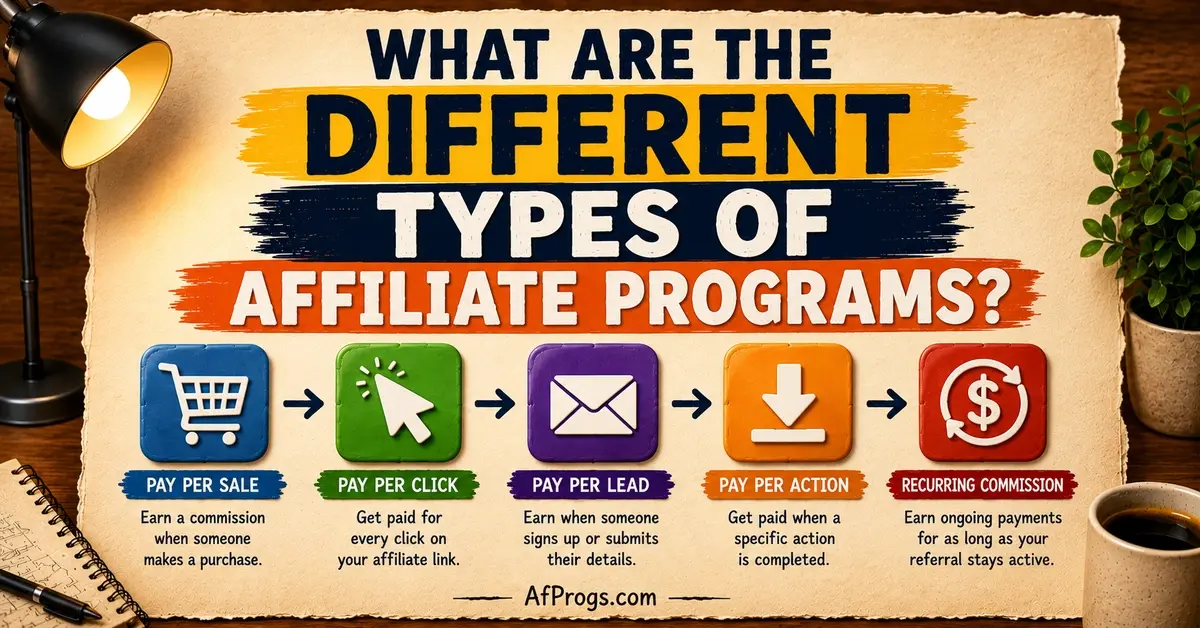
- Six payout models cover how you get paid: pay-per-sale, pay-per-lead, pay-per-click, pay-per-trial, recurring, and hybrids that bolt two of those together.
- A 40% recurring commission and a 40% one-time commission are not the same offer. One pays once, one keeps paying while the customer sticks around.
- Cookie length quietly decides what any commission rate is really worth to you. Two programs at 10% can pay wildly differently.
- The right type isn’t the highest number. It’s the one that matches your traffic, your niche, and how long your readers take to decide.
One program pays you 5% of a sale. Another pays 40% every month for as long as the customer stays subscribed. A third drops $200 in your account when someone signs up for a free trial and doesn’t spend a penny.
All three are affiliate programs. Those three numbers refuse to sit next to each other in any way that makes sense, which is exactly why beginners keep asking, “What are the different types of affiliate programs?”
Comparing them cold is like comparing a bus ticket, a taxi fare, and an annual travel pass. Same rough idea. Completely different maths.
So let’s sort them into piles.
What Are the Different Types of Affiliate Programs?
Affiliate programs are grouped two ways: by how they pay you, and by what you’re promoting. Most real programs are a combination of the two, which is why beginners get tangled up.
An easy example. Amazon Associates is a retail program (what you promote) that runs on pay-per-sale (how you’re paid). A software tool might be a subscription program that runs on recurring commissions. A finance brand might be a lead generation program paying a flat fee per form filled in.
Once you can name both halves, every program page you read starts making sense. You stop staring at a big percentage and start asking what has to happen before that percentage turns into money.
Two other things get sorted in this niche as well, and they’re worth flagging now so they don’t ambush you later: how a program is hosted, and what kind of affiliate you count as. Both change which programs will have you. We’ll come to those once the money side is clear.
Why Is It Important to Understand Different Affiliate Programs?
Because the type of program decides how much traffic you need, how long you wait to get paid, and whether your work keeps earning after you’ve published it.
Take two programs paying “20%.” One is a $30 gadget, so that’s $6 a sale. The other is a $99-a-month tool paying 20% for as long as the customer stays. Same headline number. Radically different outcomes for the same amount of writing.
If the mechanics behind tracking links and commissions are still fuzzy, our guide on how affiliate programs work covers the plumbing before you go any further here.
What Are the Different Types of Affiliate Program Payout Models?
There are six payout models you’ll meet as a beginner: pay-per-sale, pay-per-lead, pay-per-click, pay-per-trial or install, recurring, and hybrid. Everything else is a variation on those.
Hybrid is the one that trips people up. Picture an email tool that pays you a fixed amount when a reader starts a free trial, then a larger amount if they upgrade to a paid plan.
Two payouts, one referral, two different triggers. Semrush runs exactly that arrangement, paying a flat fee per sale plus a smaller amount per free trial.
One word on pay-per-click before you get excited. Getting paid for a click sounds brilliant right up until you see the number.
Genuine pay-per-click programs are rare, and the per-click payouts are small enough that you’d need traffic most beginners won’t see for years. File it under “nice idea, come back later.”
Affiliate Program Types With Examples, Sorted by What You Promote
Payout models tell you how the money arrives. This second grouping tells you what you’ll actually be writing about.
Retail and Marketplace Programs
These are the big shops. Amazon, department stores, outdoor retailers, sportswear brands. You review or recommend physical products, someone buys, you get a percentage.
Rates are usually modest. Amazon’s own category rate table sets different percentages for different product groups, and plenty of everyday categories sit in low single digits.
The trap that catches nearly every beginner is that the rate follows the category purchased, not the product you linked to. Link a $20 book, watch them buy a $600 fridge in the same session, and you’re paid at the fridge’s rate. Sometimes that’s a lovely surprise. Sometimes it isn’t.
Retail programs suit review sites and gift guides, where readers arrive already holding their wallet.
If you want to see how one of these programs stacks up in practice, my REI affiliate program review covers its commission rate, cookie window and payout terms.
I’ve earned from this type myself. Back in 2011 I built a Squidoo page around cheap plus size Halloween costumes, promoted them through Commission Junction, and by October 24, 2011 it had earned over £70 in commissions with sales landing daily right through Halloween.
Not life-changing money. But it was real, it came from one page, and it taught me more about buying intent than any course had.
Those are my own results from a specific campaign at a specific time, not a typical outcome, and yours will vary.
Subscription and Software Programs
You promote a tool people pay for monthly. Email software, hosting, VPNs, design apps, SEO platforms.
What makes this pile different from retail is that you’re not selling a one-off object. You’re introducing someone to a habit. The tools that convert best are the ones your reader will still be opening every Monday morning a year from now.
These programs suit anyone whose audience has an ongoing job to do. If your readers need the thing every month, you’re in the right pile. If they’d use it once and cancel, you’re not.
Digital and Info-Product Programs
Courses, ebooks, memberships, templates. Commission percentages here are often far higher than retail, because there’s no warehouse and no shipping.
Judging these offers takes a bit more care. A big percentage on something nobody buys is worth nothing, which is why marketplaces publish average earnings per conversion, blending the upfront sale and any rebills into one number. That figure tells you far more than the headline rate does.
High Ticket Programs
Same idea, bigger price tags. High ticket offers generally start around $100 per sale and climb from there, sometimes into four figures.
Fewer sales needed, obviously. The trade-off is that nobody spends $2,000 on a whim after skimming one blog post, so these usually need trust, follow-up, and a longer runway.
I promoted ClickFunnels products this way from 2017, using a free webinar script as the front door with subscriptions and bigger courses sitting behind it. That approach passed $5,000 in commissions in its first year. Again, my own numbers from my own campaign, not a promise of what anyone else will earn.
Lead Generation and Free Trial Programs
You get paid for a form, a quote request, a trial signup, or an app install. No purchase required.
The conversion is much easier, since you’re asking for an email address rather than a credit card. Payouts are fixed and smaller. A pet insurance brand might pay you per quote request. A dating site might pay you per free signup, which is the same idea wearing a different hat.
Lead generation suits you if your traffic is curious but not yet in a buying mood, which describes a lot of early-stage blogs.
What’s the Difference Between Recurring and One-Time Commissions?
A one-time commission pays you once for a sale. A recurring commission pays you every billing cycle for as long as that customer stays subscribed.
The comparison people get wrong is assuming bigger is better. A $150 one-time payout beats a $12 monthly recurring payout for the first year. After that, the recurring one quietly walks past it and keeps going.
What nobody mentions to beginners is that recurring only pays while the customer keeps paying. A referral who cancels in week three pays you once, and that $12 buys a Happy Meal with enough left over to feel slightly insulted.
Run your own numbers rather than trusting mine. My commission calculator lets you plug in traffic, conversion rate, order value and recurring payments to see which model actually suits the audience you’ve got.
Patience is the price of admission here. I’ve referred members to Wealthy Affiliate for years, and on February 12, 2024 two yearly upgrades landed within two minutes of each other, totalling $640 in a day.
That work was done months earlier. Which is the honest shape of recurring income: nothing, nothing, nothing, then two at once while you’re making toast.
My results, not a typical outcome, and individual results vary.
How Does Cookie Duration Change What Each Type Is Worth?
Cookie duration is how long after someone clicks your link you can still get credit for the sale, and it changes what any commission rate is worth to you.
Most programs land somewhere between seven and 90 days, with 30 days being the common middle ground. Amazon is the famous outlier at 24 hours, softened slightly by a longer window on anything added to the basket during that first day.
Here’s why it matters. Two programs both offering 10% are not the same offer if one gives you 24 hours and the other gives you 60 days.
The 24-hour program needs a reader who buys today. The 60-day program still pays you when your reader wanders off, thinks about it over a weekend, asks their partner, and finally buys three weeks later. Which, in fairness, is how most humans actually shop.
Match the cookie to how long your product takes to decide on. Impulse buy, short cookie is fine. Big purchase, short cookie is a slow leak.
What’s the Difference Between Network Programs and In-House Programs?
A network hosts hundreds of brands behind one login and pays you once for all of them. An in-house program is run by the brand itself, with its own dashboard, its own rules and its own payment.
Networks are usually the easier starting point. You join a network once, apply to individual advertisers inside it, and build your tracking links from one place.
One payment threshold. One tax form. One password to forget.
In-house programs often pay better, because there’s no middleman taking a cut. The cost is admin. Five in-house programs means five logins, five minimum payouts to reach separately, and five sets of terms you agreed to and definitely read in full.
You Get Sorted Into a Type as Well
Programs aren’t the only thing being categorised here. Networks also sort affiliates, and the category they drop you into decides which programs will accept your application. Beginners rarely think to check this until a rejection email turns up.
The recognised publisher types include content creators, social influencers, coupon and discount sites, cashback and loyalty platforms, email marketers, and comparison sites. Most beginners reading this are content creators, which is the category with the fewest restrictions attached to it.
Read the terms before you apply anyway. Plenty of brands ban coupon partners, restrict paid search, or block certain social platforms outright. There’s nothing more annoying than writing 3,000 words for a program that was never going to accept your traffic source.
Which of the Different Types of Affiliate Programs Suit Beginners Best?
There isn’t one best type, and anyone giving you a single answer is selling something. The right type depends on the traffic you already have.
Three honest starting points:
- Retail or marketplace: if your content is reviews, comparisons, and gift guides. Readers arrive ready to buy, the programs accept almost everyone, and you’ll get your first commission faster.
- Subscription or software: if your audience pays for something monthly, like hosting, email software or a design tool. Slower to start, better later.
- Lead generation: if your content answers questions rather than recommends products. Those readers aren’t shopping yet, so a free signup is a smaller ask.
Whichever pile you choose, choose one. Stick with a single program and product until you have solid earnings coming in, then add two more as traffic grows.
My guide on how many programs to join covers why spreading yourself thin is the fastest way to promote six things badly.
Which Types of Affiliate Programs Should Beginners Avoid?
Any program where the money comes from recruiting people rather than selling products.
Recruitment programs get dressed up in affiliate language, which is exactly why beginners fall for them.
The FTC separates lawful from unlawful compensation structures on one question: is the reward tied to real sales, or to signing up more participants? If the product is basically the opportunity itself, walk away.
I’ve been on the wrong side of this one. Back in the early 2000s I promoted a multi-level marketing company selling domain names, where signing people up was easy and getting any of them to buy was not.
Commission only landed on actual sales, at $1 per domain, per month. Ten domains meant $10 a month, and most cancelled within months, dragging me back to zero.
Meanwhile hundreds of pounds went into Google Ads I had no idea how to run. Costs climbing, commissions evaporating. Google, it turns out, is not a cheap tutor.
Low-commission programs rarely support paid ads for a beginner with no budget and no testing experience. If you’re starting out, earn your first commissions organically.
One more pile to skip: any program that won’t publish its terms, its cookie length, or its payment threshold until you’ve signed up. My guide on picking a program covers the rest of the checks worth running.
What Applies to Every Type of Affiliate Program?
Disclosure. Every type, every platform, every audience size.
Affiliate relationships have to be disclosed clearly and conspicuously, in plain language, close to the link rather than buried at the bottom of the page. There’s no small-blog exemption. Ten readers a month or 10,000, the rule is the same.
Three things beginners get wrong here.
Placement is the big one. A disclosure sitting in your footer, or on a separate page nobody visits, doesn’t cover a link halfway down a review. Put it above the content, where a reader meets it before they meet the link.
Wording catches others out. Labelling something an ‘affiliate link’ and assuming that covers you is a gamble, because most readers don’t know what the phrase means. Say you earn a commission. Those are words everybody understands.
Then there’s the belief that any of this only applies to blog posts. It follows the link wherever the link goes, so your emails, your videos and your social posts all need it too.
Most affiliate agreements require disclosure in their terms too, so skipping it risks your account as well as a fine. All of which makes it a strange thing to gamble on, given the fix is one sentence sitting near the top of your post.
Sorting Your Own Programs Into Piles
Four questions will place almost any program you come across.
- Does my audience genuinely buy this?
- Does the payout model match the traffic I have right now?
- Does the cookie window match how long this purchase takes to decide on?
- Will they actually accept my traffic source?
Get all four right and the type sorts itself out. Get the first one wrong and nothing else matters, because a 50% commission on something your readers don’t want still pays exactly nothing. You can’t talk a percentage into existence by staring at it hopefully.
The types aren’t there to confuse you. They’re there so you can stop guessing, look at any program page, and know within about a minute whether it’s worth your time.
Your ‘still-sorting-programs-into-piles’ partner, Neil.