
TL;DR
- Affiliate programs are not rare. A plain Google search, brand footers, directories, marketplaces, networks and the finder tools built for the job will hand you more programs than you could ever promote properly.
- Your niche plus the words “affiliate program”, typed into Google, costs nothing and gets you further than most beginners expect.
- Brands you already spend money with usually run a program, and the link is sitting in their footer where nobody looks.
- Finding programs is quick. Checking the commission rate, the cookie window and how each one pays before you apply is what stops you pointing 20 posts at the wrong program.
- A program finder tool cuts the searching down to minutes, and it comes with a Wealthy Affiliate account alongside the training and community behind it.
You’ve typed “where can I find affiliate programs” into Google and landed on your fourth listicle of the morning. Five programs, and you recognize every one of them from the last three you opened.
I write roundups like that myself, so I’m not throwing stones. What those lists rarely tell you is which programs the writer has actually promoted, and that’s what decides whether their advice is worth anything to you.
They also leave out how much is out there. Those lists are short because attention spans are, not because the programs ran out.
Accepting that took me an embarrassingly long time. I spent years assuming the good ones were rationed.
What’s rationed is your attention, your traffic, and how many programs you can promote properly at once. Roughly one, when you start out. Six routes below, including the one I use now that cut the job down to about two minutes of clicking.
Where Can I Find Affiliate Programs?
Google itself, the websites of brands you already buy from, curated program directories, digital product marketplaces, affiliate networks, and finder tools. That covers almost every program you will ever join.
Here’s the map before we take each one in turn:
- Google: free, unglamorous, and where every beginner should start.
- Brand websites: in-house programs run by companies themselves, with no network sitting in the middle.
- Program directories: curated lists sorted by niche, handy when your topic is too small for the big networks to bother with.
- Digital marketplaces: products sold direct by their creators, from courses and memberships to supplements. ClickBank and Digistore24 are the two most beginners meet first.
- Affiliate networks: one account, thousands of brands, one dashboard. Awin, CJ, Rakuten Advertising, ShareASale, FlexOffers and Impact all work this way.
- Program finder tools: software that does the searching for you, which is where I’ve ended up.
Almost everyone ends up mixing them, at least until one route starts doing most of the work. Cookies, tracking links and who actually pays you are a separate rabbit hole, one I’ve already been down in how programs work, so I’ll leave it out of this one.
Is It Hard To Find Affiliate Programs?
No. The finding is quick, and the choosing is what drags.
Beginners hit the opposite problem to the one they expect. You go looking for a single program, you turn up 40, and by midnight you’ve signed up to a dozen because every one of them looked promising. Come the weekend you’re staring at a pile of dashboards that owe you nothing, spread across posts you haven’t written yet.
Guilty, more than once.
One program, promoted properly, and no second one until the first is actually paying you something. That gets harder to stick to the longer your shortlist gets.
How Do I Find Affiliate Programs in My Niche?
Type your niche plus the words “affiliate program” into Google. That’s the method, and it’s the one I reached for first through most of 25-plus years of doing this.
Run the variations too:
- “your niche + affiliate program”
- “your niche + partner program”
- “your niche + referral program”
- “your niche + ambassador program”
- “your niche + creator program”
- “brand name + affiliates”
- “best + your niche + affiliate programs”
Those labels don’t all mean the same thing. Partner is usually another word for affiliate, while referral, ambassador and creator programs can run on different terms, so check what each one pays before you assume there’s a commission behind it.
Forums are my second stop. Searching your niche plus “affiliate program” on Reddit or Quora surfaces affiliates arguing about payout delays and rejected applications, which is information no brand puts on its own page.
Read the complaints rather than the recommendations. A thread full of people moaning about a 60-day payment hold tells you more than any review post will.
Do this bit first, before anything else in this post. Google gets you a list of names in half an hour, and most of what follows is about turning that list into programs you can actually join.
How To Find an Affiliate Program on a Brand’s Own Website
Look in the footer.
Almost every brand hides the link down there, labeled Affiliates, Partners or Affiliate Program, tucked between the privacy policy and the careers page. Footers get ignored, which keeps this route quiet while everyone else queues up for the 10 programs every listicle recommends.
Not every program sits on a network. Plenty of brands run their own programs directly instead, though the ones paying for sign-ups rather than sales will usually want proof of traffic before anyone discusses terms with you.
Begin with what you already spend money on each month. Web hosting, email software, keyword tools, the subscriptions sitting on your bank statement right now.
Next, look at what you buy for whatever you do at weekends. Fishing tackle, bike components, wool, running shoes, camera lenses, board games.
That second group is worth more than people realize. You own the products, you’ve formed opinions on them, and a reader can tell the difference between someone who bought something and someone who read the spec sheet. Recommending products you use is the whole basis of trust in this game, and approaching a small brand’s founder directly will often get you better terms than the public page advertises.
Watch for one thing before you sign up anywhere. Real programs don’t charge you for the privilege of promoting them, so a monthly fee attached to the affiliate link itself is a paid course wearing a badge.
Paying isn’t automatically a scam, though. I paid $7 a month for Partner With Anthony and got genuine training for it, then found the required tools and traffic packages waiting behind that. Whether a program is free to join comes down to what the fee buys. Paying for training is one thing, paying for the link itself is another.
Where Can I Find Affiliate Programs for Digital and SaaS Products?
On the digital marketplaces, and on the websites of software companies themselves. ClickBank and Digistore24 are where most beginners land first.
What sits on those marketplaces is broader than people assume. Courses, memberships, software (SaaS), and a fair amount of physical product too, most of it sold direct by whoever made it. Both carry recurring offers alongside the one-off ones, which is the reason a lot of affiliates end up there.
Software companies are worth approaching directly as well. HubSpot, GetResponse, and Aweber, to name a few, all run their own recurring programs, though they won’t suit every niche.
Gardening isn’t exactly crawling with SaaS.
How To Find an Affiliate Program in a Directory
Directories are almost the biggest time-saver I’ve found for this job. 100s to 1,000s of programs in one place, filters for commission rates, cookie windows and payment details, and no bouncing between 20 brand websites trying to hold it all in your head.
You also find programs Google never shows you. The listicles cover the same big names every time, and the unique niche ones are sometimes in the directories instead.
Affiliate Program Database is the one I go back to. It sorts by every angle I can think of, newest, best, highest paying, commission type, product type, and the editorial picks do the digging for you. Every program detail is there without creating an account.
Over on Affiliate.Watch the listing runs by actual niche instead, fashion, travel, design, to name some, alongside trending categories and the payment methods people choose most. Signup is optional there too.
Some networks run their own. FlexOffers lists everything in its system across the full spread of categories, though it mostly shows the commission payout and the EPC figure reads $0 every time. You join and the rest of the metrics can show up before you commit to a program.
Where To Find Affiliate Programs Inside an Affiliate Network
Inside the dashboard, once you’ve registered. Signing up is free, and a searchable list of every brand on that network opens up to you.
A network works like a shopping mall. One account gets you through the main doors, then each shop inside still decides whether to let you in.
Browse the advertiser list by brand or category, and each program shows its commission rates and terms before you apply to a single one. Those numbers are the nearest thing to an honest preview you’ll get, so read them properly rather than skimming for the biggest percentage. Bigger networks run the same idea at volume, with over 12,000 advertiser programs reachable through a single publisher account.
Filling in applications is not a thrilling way to spend a Tuesday. It ranks somewhere between a tax return and a set of flat-pack furniture instructions.
Do it anyway. One sitting gets you a program list you’ll be working from for years.
How I Find Programs Fastest Now
With a program finder tool. Wealthy Affiliate’s Business Hub has one built into it, and it does the searching for me.
Everything above still works, mind you. I just barely use any of it these days.
Pick a niche and it returns programs by category, showing the company, the commission percentage, an estimated commission per sale and a route through to the signup page.
It handles narrow niches too. I ran portable basketball hoops through it and got back eight brands including Spalding, Goalrilla and Silverback. Rates are listed beside each one.
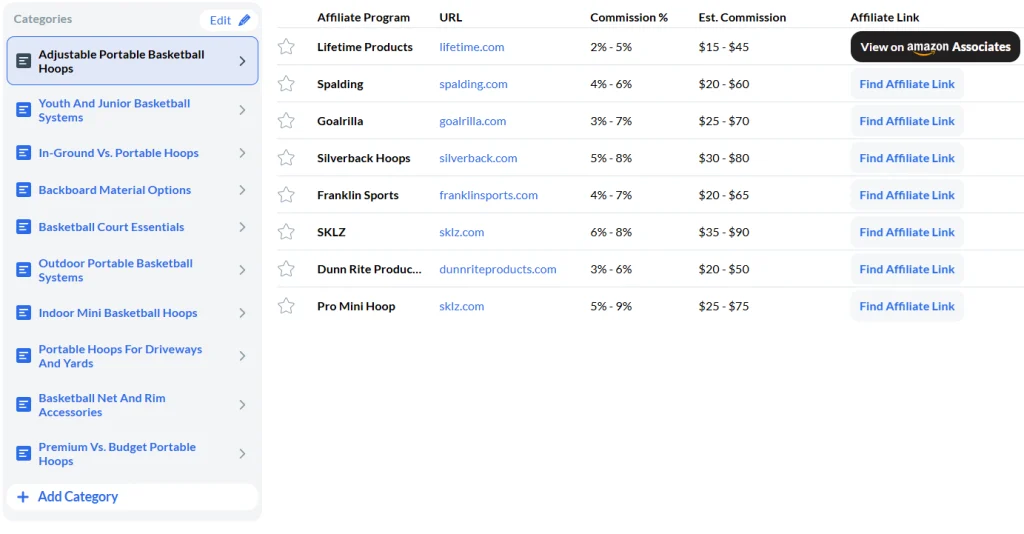
Two minutes of clicking against half a morning of searching and pasting results into a spreadsheet. I’m not going back.
Free up your time. Decide website or social first, and the finder comes with your Wealthy Affiliate account.
Which Affiliate Programs Keep Paying After the First Sale?
Memberships, subscriptions and software, for as long as that customer stays signed up. A physical product might pay you 4% of a $40 sale, once, and that’s the end of it.
That difference is what pushed me toward software companies directly. I joined the ClickFunnels affiliate program in 2017 and used Russell Brunson’s free Perfect Webinar script as the way in, with the funnel behind it upselling backend products and a subscription.
Commissions crossed $1,000 in total by that September, and the first year came in above $5,000, including $3,964.45 through the ClickFunnels Affiliate Center, $1,070 on Perfect Webinar and $300 from One Funnel Away.
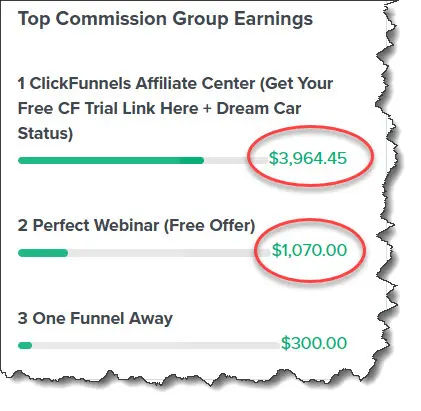
It took a year to build that total, not one big payday. Brunson’s name on the front of it did plenty of the selling too, and I’d be kidding you to claim otherwise.
Recurring offers turn up well beyond software. Anything people pay for monthly works the same way: meal kits, vitamins, razors, pet food, streaming.
How Do You Compare Programs Once You’ve Found Them?
Commission rate, cookie window, and how the program actually pays you. Those three settle most decisions.
The cookie window is the bit beginners meet for the first time. Click an affiliate link and a small file lands on that person’s device, and the window is how long it keeps crediting you if they come back and buy later. Most cookie durations run between 30 and 90 days, and a 24-hour window on a product people research for weeks loses you commissions you already earned.
Rate is the number that flatters a program the most, which is why beginners stop reading there. Which action triggers your commission matters as much as the percentage, because some programs pay per sale and others pay per lead, meaning you earn when someone signs up or requests a quote without buying anything.
Match that against your own audience instead of chasing the bigger number. A crowd of browsers can earn you almost nothing on a percentage, while payment models paying under $0.30 per verified lead do better.
Do the math before you commit. A 5% commission on a $20 product is a dollar a sale, and at the average ecommerce conversion rate of 1.84%, that’s roughly 5,500 visitors to reach your first $100.
Sit with that number for a second. It’s the reality behind a lot of programs described as beginner-friendly.
How To Find Affiliate Programs for Beginners With No Traffic Yet
Aim at smaller brands, because they approve people the big retailers turn down. A company nobody’s heard of wants you far more than a household name does.
You’ll find those smaller brands on marketplaces and directories, which are websites listing hundreds of programs in one place so you can browse instead of hunting each company down separately. Plenty of small and mid-size ecommerce brands list their programs on an affiliate marketplace, free for affiliates to browse and join.
There’s a trade-off attached. Lower brand recognition means your reader trusts the recommendation less, so more of the selling falls to you. What you gain is approval, a live dashboard, and the mechanics learned on a working program instead of in theory.
Publish three or four useful posts before applying anywhere fussy, and weigh what you find against the criteria in choosing a program. Review teams look at your site, and an empty one with a contact page is an easy no.
What Happens If a Program Rejects You?
Nothing much, and it happens to everybody.
Rejection is an automated filter doing its job, not a verdict on you. Three things cause most of them: a thin site, no traffic record, or a niche the reviewer decided didn’t match yours.
Go after automatic approvals while you build. Some advertisers accept publishers the moment an account goes live, which gets you a working link and something real to practice on.
Reapply three months later with 20 to 30 quality posts and search traffic behind you. Same site, a much stronger case.
Where To Start Looking Today
Affiliate programs sit in network dashboards, on marketplaces and directories, in brand footers, in Google’s results, and inside the tools built to hunt them down. Locating them was never the hard part
Want a shortcut? Write down five products you already pay for and search each one plus the word “affiliates”. You’ll have a shortlist inside 20 minutes, no course or PDF required.
Or use Wealthy Affiliate’s finder tool, the method I use now, to speed up the process.
Check the rate, the cookie window and how each one pays, then run your own traffic through a commission calculator. Pick up to three programs that fit your niche and leave the rest.
Your ‘still-scrolling-to-the-footer’ partner, Neil