
TL;DR
- Almost every affiliate program worth your time is free to join. You apply, you promote, and the commission gets paid once somebody buys through your link.
- The fees in this industry sit on the merchant’s side of the table, not yours. A brand pays hundreds just to get itself listed on a network, which is exactly why it has no reason to charge you.
- Watch for two real charges: a small refundable verification deposit, and a paid buy-in that keeps you eligible for commissions. Training sold as if it were the program is the third thing people mistake for a fee, and it isn’t one.
- Three times in twenty-seven years I’ve handed money over for affiliate access, and I’d tell any beginner to keep their card in their pocket until a program that charges nothing has already paid them something.
- When a program wants cash before you’ve earned a dime, that’s not automatically a scam. It’s your cue to slow down and check three specific things.
Somebody has pitched you an affiliate program with a price tag on it, and now you’re sitting there thinking ‘hang on, do you have to pay for affiliate programs, or is this one taking liberties?’
Maybe it arrived as an ad. Perhaps a YouTube guru, or an email offering exclusive partner access for a monthly subscription.
And you’re checking before you hand anything over. Good instinct.
The internet answers this one twice, confidently, in opposite directions. Neither answer tells you which of the two applies to the offer sitting in front of you.
Getting it wrong costs you in both directions. Pay when you shouldn’t and you’re funding a subscription instead of a business. Refuse on principle and you’ll walk away from perfectly good networks over a deposit that was coming back to you anyway.
Twenty-seven years in, and I’ve paid up three separate times just for the right to be somebody’s affiliate. Two of those I’d take back.
So here’s the honest answer, the three fees you might actually run into, and how to work out which one is in front of you.
Do You Have to Pay for Affiliate Programs?
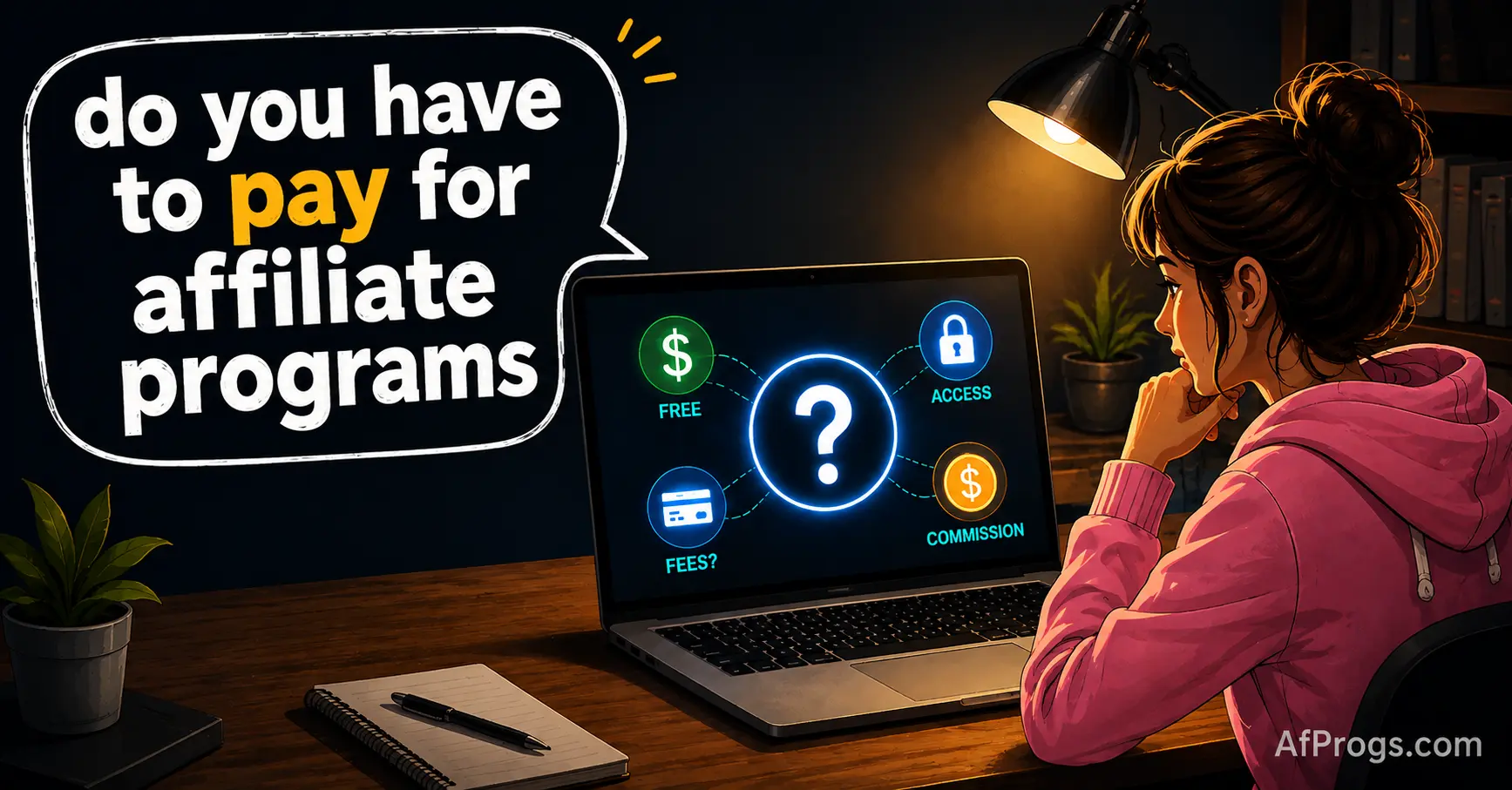
No. The majority of affiliate programs cost nothing to join, and that includes almost every program a beginner will realistically come across in their first year.
Pick any merchant you’d genuinely want to promote and go and read their partner page. Retail brands, software companies, print-on-demand platforms: the application asks for your details, your website or social account, and your tax information. Nowhere does it ask for a card number.
That’s the model working exactly as designed. A merchant only owes you a commission once you’ve delivered a sale or a lead, so there is nothing for them to protect by taking your money at the door.
Charging affiliates would actively lose them money. Every fee is a person who doesn’t sign up, and every person who doesn’t sign up is a promotion that never happens.
It’s a bit like a store charging you for the privilege of handing out its flyers.
Networks tell the same story from their side of the fence. Awin, which hosts thousands of separate merchant programs under one roof, tells publishers on its own pricing page that they start with no setup fees and no hidden charges.
So zero cost is the sensible default. Anything else is the exception, and exceptions need a reason.
Are Affiliate Programs Free to Join?
Yes, though beginners tend to hit two different sign-ups without realizing they’re not the same thing.
An affiliate program belongs to one merchant. If the company runs its program itself, you apply directly to the brand to promote its products or services and earn a commission when someone you refer buys something.
Networks are the middlemen. CJ, ShareASale, ClickBank and Awin each host thousands of separate merchant programs behind a single login, so you apply once to the network and then apply again to individual brands inside it.
Both stages are open to you at no charge. ClickBank confirms as much on its own site, where affiliates open a no-cost account before browsing the marketplace for offers.
Costing nothing is not the same as letting anyone in though.
Amazon, for example, wants you to be 18 or older with a valid tax ID, an active site or social account, and genuine content on it, and a human checks your Amazon application before you’re approved.
So the barrier is your content and your credibility, not your bank balance.
One consolation: a rejected application costs you nothing but a bit of pride. Getting to grips with how programs work before you apply tends to fix the credibility problem faster than waiting does.
Why Are Some Affiliate Programs Free?
Because the merchant is already paying, and they’re paying a lot more than you’d guess.
A brand that wants affiliates promoting its products doesn’t get to list itself for nothing either. ClickBank’s own comparison puts ShareASale seller costs at a $625 setup fee plus a $125 deposit into the merchant account before a single affiliate has promoted anything.
Those costs come back out of sales that affiliates make, which is the whole reason the merchant wants you signed up rather than priced out.
ClickBank itself charges sellers a one-time $49.95 activation fee to list a product.
That figure causes more confusion than anything else in this niche. Beginners find it, assume it’s the price of becoming a ClickBank affiliate, and quietly close the tab. It isn’t. It’s what a product owner pays to be sold by people like you.
Once you see the money flowing in that direction, charging affiliates stops making commercial sense entirely. Their costs are already covered before you arrive, and your commission only becomes payable after you’ve produced a result.
You’re the sales team they don’t pay unless you sell. Nobody bills the sales team.
Why Is There a Fee for Some Affiliate Programs?
Because “fee” gets used for several different things, and most of them aren’t a fee charged to you at all.
Here’s the split, because knowing which one you’re looking at settles the question in about thirty seconds:
| What You Are Looking At | What It Actually Is | Should a Beginner Pay It? |
|---|---|---|
| No charge at all, which is the norm | The merchant’s own affiliate program, applied for and approved without a payment at any stage | Nothing to pay. Almost every program you come across works exactly like this |
| Refundable verification deposit | A one-off deposit taken by a few networks when you open your publisher account, not by any program inside it | Fine to pay. It is refunded to you on your first payout |
| Paid buy-in to stay eligible | A recurring charge you must keep paying or you stop earning commissions | Depends entirely on the price and what the subscription gives you besides eligibility |
| A paid course mistaken for an entry fee | A course, membership or system with its own affiliate program attached, so the price gets mistaken for the cost of joining | Buy it for the training or not at all. Where joining is open without it, the purchase is optional. Where the subscription is required, treat it as a monthly cost you have to clear before you profit |
The first row is what you’ll meet almost every time you apply. Everything under it is an exception, and only the buy-in can actually stop you earning.
No charge at all
Nothing to explain here, which is rather the point. You apply, you get approved or you don’t, and your card never comes out at any stage.
That’s how the overwhelming majority of programs a beginner will ever look at are set up, and it’s the benchmark the other three get measured against.
If a sign-up screen surprises you with a payment, this is what it’s deviating from.
The refundable verification deposit
Awin is the one you’ll run into, and it’s worth explaining properly because their own materials aren’t perfectly consistent.
One page says publishers join at no cost. The FAQ section mentions a refundable deposit taken from new publishers for compliance and quality reasons, and third-party write-ups quote different amounts, which tells you the figure has moved over the years.
Either way, it’s small, and it doesn’t stay with them.
Shopify’s network guide confirms the part that matters, which is that the money comes back once you reach your first payment threshold.
That’s a doorman checking ID, not a cover charge. Money that comes back to you isn’t a fee, it’s proof that a real person with a real card is behind the application.
The paid buy-in
Here you pay monthly, and that payment is what keeps you eligible to earn. Stop paying, stop earning, no matter how much traffic you sent last month.
Whether that’s a problem depends on the number and what sits behind it. I’m on a training platform at nine dollars a month right now, and that same subscription keeps me active as an affiliate. Nine dollars for training I’d pay for anyway is a membership, not a scam.
Others look identical on the sign-up page and turn out very differently. A low fee gets you in, then the tools cost extra and the traffic packages cost more again.
Ask one question and most of them expose themselves: would this company still make money if nobody ever recruited another affiliate? If the honest answer is no, the fee isn’t covering costs, it is the revenue.
None of this is theoretical. In one FTC case, a credit repair operation was alleged to be a pyramid scheme where agents paid $299 up front to participate, with consumer losses put at more than $213 million.
Price alone won’t tell you which kind you’re facing. Price plus whatever you’re expected to buy next will.
A paid course mistaken for an entry fee
Most of the confusion in this niche lives right here, because often it isn’t a fee at all.
You buy a course. That course also happens to run an affiliate program. Somebody online says they “paid to join” it, and now you think the program itself has a price tag.
It usually doesn’t. Buying the training and joining the affiliate program are two separate transactions on plenty of platforms, and where that’s the case the second one costs nothing whether you did the first or not.
Some platforms do tie the two together, which is the buy-in situation again rather than this one. Check which you’re dealing with before you decide, because the answer changes what you’re actually being asked to pay for.
Where access is open either way, judge the training purely on whether the training is worth having. That decision has nothing to do with joining the program.
The Three Times I’ve Actually Paid to Be an Affiliate
Right, my turn in the confession box.
First was Global Domains International, the .ws domain company, back in the early 2000s. Ten dollars a month, every month, and if I stopped paying I stopped being an affiliate. I was paying a company for the right to go and find them customers. But I did also get a domain name.
Second was Partner With Anthony at seven dollars a month, and fair play, that did include basic training on setting up and promoting the done-for-you system. What the price tag hid was everything after it: tools needed before the system would run properly, then traffic packages sold alongside it, extortionate money for junk clicks that were never going to buy anything.
I still earned from it, passing my first $100 in cumulative commissions from sales between $3.50 and $49.50. Results not typical, and individual results will vary.
Third is the oldest and the sneakiest. In the late 1990s I bought Stephen Ducharme’s book on getting traffic without paying for advertising, then became an affiliate for it. That program cost nothing.
My money went on the “protégé” upgrade at thirty-odd dollars a month. That gave me a second-tier commission whenever an affiliate I’d referred went on to bring in a customer, with that person also added straight to my own email list.
Read that last part again. I was harvesting a list out of other people’s referrals, and their referrals’ referrals, on down the line.
Here’s the pattern across all three: the affiliate program cost nothing in every single case. The money always went on something bolted to the side of it.
Should You Pay for Affiliate Programs as a Beginner?
No, not for access on its own. Paying for training that happens to include affiliate eligibility is a different question, and that one comes down to whether the training is worth the money.
Paying purely for access can also mess with your judgment, and it has nothing to do with whether the fee is $10 or $100.
Once you’ve handed over a monthly fee, it’s easy to start defending the thing because you’ve paid for it. Before you know it, you’re trying to make your money back instead of asking whether the program is any good in the first place.
My standing advice hasn’t changed in years. Do your due diligence on anything promising fast results with no work, because if it sounds too good to be true, it is. And don’t be a shiny object chaser, because course-hopping produces information overload and nothing else.
Pick one program you can genuinely stand behind and stick with it long enough to see if it earns. My guide on how many programs covers where that number goes once the first one is working.
How Do You Tell a Legitimate Fee From a Red Flag?
Ask where the money comes from, because that single question separates a real business from a chain letter.
The FTC’s guidance on multi-level marketing puts it plainly. Rewards built on recruitment rather than genuine product sales get treated as an elaborate chain letter, and most people caught in those structures lose both money and time.
Genuine programs make their money when customers buy something. Schemes make their money when people join.
Investor.gov gives you the shorter version. Heavy emphasis on recruiting over selling to actual customers is the warning sign that matters most.
Here’s your three-part check before paying anything:
- Where does the commission come from: if you earn more for signing up other affiliates than for selling to actual customers, walk away. That’s the single clearest signal in the whole list.
- Does the paperwork exist: under the FTC’s rules, a seller taking a required payment for a business opportunity has to hand you a disclosure document at least seven calendar days before you sign or pay. No paperwork, no payment.
- Will the fee come back: a refundable deposit returned on your first payout is a verification step. A recurring charge that keeps you eligible is a subscription to your own job.
Any one of those failing is enough to stop. You don’t need all three.
What Are the Risks of Free Affiliate Programs?
Free entry still carries risk, it just isn’t financial risk. What you’re putting on the table is your time and your content.
The biggest one is that you don’t own the platform. I’ve had content-hosting sites lose their search visibility and then close down altogether, taking years of work with them.
No cost to join, none to build on, gone.
The other risks worth planning around:
- Approval isn’t guaranteed: programs like Amazon review your site and your content before letting you in, so thin content gets you rejected regardless of your enthusiasm.
- Terms change without asking you: commission rates, cookie windows (the number of days you stay credited for a click) and excluded product categories can all be revised by the merchant, and nobody phones you first.
- Inactive accounts get closed: plenty of networks clear out affiliates who haven’t produced results after a stretch of months.
None of that is a reason to avoid them. It’s a reason to build on ground you actually control, which is why I keep pushing beginners toward a site of their own rather than somebody else’s platform.
Vetting the terms before you commit takes an afternoon and saves you months. My guide on picking a program runs through the payout and cookie details worth checking first.
What Starting as an Affiliate Actually Costs
Zero to join, and whatever you choose to spend to operate. Those two numbers get mashed together constantly, and separating them clears up most of the confusion around this question.
Joining costs nothing. Running a business that gets traffic to your affiliate links costs whatever you decide to spend on training, tools, support, and maybe ads.
My cleanest example of that first number being zero came in 2011. I built a page around the keyword “cheap plus size halloween costumes”, promoting costume retailers through Commission Junction, and it hit position one on Google’s first page on October 3, 2011. By the 24th I’d earned over £70.
Commission Junction charged me nothing to join, the retailers charged me nothing to promote them, and the entire cost of that campaign was one evening of my time.
One page, on a platform that no longer exists, more than a decade ago. Results not typical, and individual results will vary.
Want to know whether a program is worth building around before create a single piece of content? My commission calculator will run traffic, conversion rate and recurring payments through the numbers for you.
My Final Word
Free is the default, fees are the exception, and the exceptions almost always turn out to be something other than the affiliate program itself.
Sign up at no cost, promote the thing properly, get paid when your referral does what the merchant needs them to do. That arrangement has outlasted every platform I’ve ever built on.
If a program wants your money first, it isn’t automatically a scam. It just goes to the bottom of the list until you’ve proved you can earn without it.
Still weighing up a site of your own against promoting from a social profile? My start here page maps out both routes, and neither one asks you for a cent.
Your ‘still-checking-the-small-print’ partner, Neil