
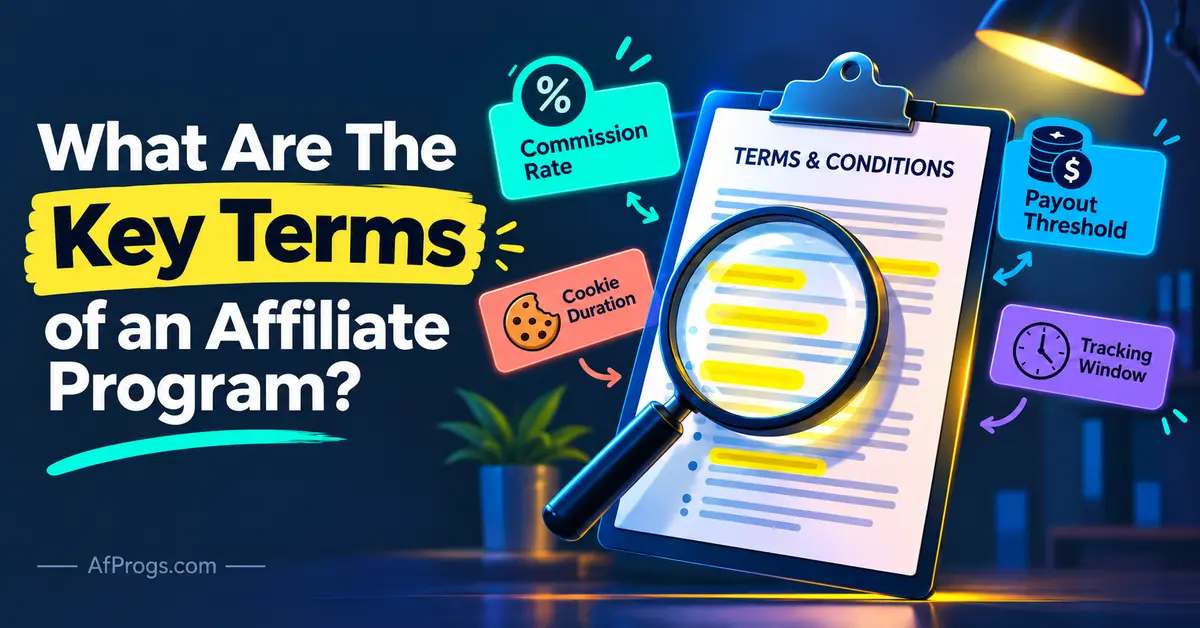
TL;DR
- Six terms decide whether you get paid: what you’re paid for, which clicks count, how long tracking lasts, when the money shows up, how you’re allowed to promote, and how the program ends it.
- A click isn’t a sale, and a sale isn’t a payment. Three stages, three ways to lose it.
- Most programs split their rules over several pages, so the one you ticked is rarely the whole thing.
- Breaking a rule by accident costs you the same as breaking it on purpose. Usually your unpaid balance.
- Read the rules before you apply, not after a commission goes missing.
You found a program that fits your site, clicked apply, ticked the little box swearing you’d read the terms, and got on with your day. That box is easy to tick without reading what’s behind it, but the affiliate program’s terms decide whether money ever reaches your bank account.
It’s the online version of nodding along to a builder’s quote and hoping the number at the bottom is the real one.
So what are the key terms of an affiliate program, and which ones decide whether you get paid?
That’s what this settles. Not the legal theory, the handful of rules that control your money.
Affiliate Program Key Terms, at a Glance
Six terms do most of the work. Every other rule in the agreement either falls under one of these or is filler a lawyer pasted in.
| Term | What it decides | Where it bites you |
|---|---|---|
| Commission model | What action you get paid for | A “sale” program pays nothing for 400 leads |
| Valid referral | Which clicks count | Another affiliate’s click can overwrite yours before the sale |
| Tracking window | How long you own the referral | Buyer takes nine days, your cookie lasted seven |
| Payment terms | When money reaches you | Earned in March, but the payout doesn’t arrive until June |
| Promotion rules | How you’re allowed to sell | One ad campaign wipes out your commissions |
| Termination | How the program ends it | Balance kept, no warning, no appeal |
Between them, those lines cover everything you’ve agreed to with that merchant. The rest is detail. Worth saying out loud: none of this is a sign of a dodgy program.
Reputable merchants that have run for years carry every rule on the list, because those rules exist to protect the merchant. That’s the job of an agreement. Knowing how tracking and commissions fit together makes the paperwork read very differently. Same words, whole new meaning.
What Are the Key Terms and Conditions of an Affiliate Program Agreement?
They’re the rules covering commission, tracking, promotion, payment and what can get your account closed. Most programs spread them over three or four pages, not the one you ticked.
Amazon’s own operating agreement makes its other rule pages part of the agreement “by reference”. Legal speak for rules that sit somewhere else and still apply to you. Translation: you agreed to pages you never opened.
Most programs follow the same shape. One main agreement covers the money side, a policies page covers link rules and banned behavior, and a third page covers who’s allowed in. Search that main agreement for “incorporated by reference” or “including any program policies”, because wherever the phrase shows up there’s another page you haven’t read.
What Counts as a Valid Referral?
A click that drops your tracking cookie, then a qualifying purchase inside the tracking window, on the same device and browser, with no other affiliate link clicked in between. Miss one of those four and the sale belongs to someone else.
Tracking windows run from a single day to 90 days or more. The exact cookie duration depends on the program, but 30 days is the rough middle.
Overwrite rules can also catch you out. Most programs pay on last click, so the final affiliate link someone clicks before checkout takes the commission, even when your review is what talked them into buying. You did the convincing. Somebody else’s blog did the collecting.
Give the word “qualifying” a second look too. Gift cards, subscription renewals, orders paid with store credit, and anything later refunded are all commonly left out, and each one gets a single sentence buried in the middle of a list.
Back in 2011, one Squidoo page of mine hit position one on Google for “cheap plus size halloween costumes”, and by October 24 that year it had made £70.18 through Commission Junction. That was my result then, not what you should expect today. Plenty clicked, far fewer bought. That experience taught me early on that getting the click is only half the job. The sale still has to happen before there’s a commission.
The Payment Terms That Decide When Money Reaches You
Earning a commission and getting paid it are two different events, sometimes months apart. Five rules control the distance between them.
- Payment threshold: the minimum you have to reach before they send anything. Usually $50 or $100, and until you hit it your money sits in their account, not yours.
- Payment schedule: net-30 and net-60 mean you get paid 30 or 60 days after the month you earned it in. Earn in January on net-60 and you’re looking at March. That wait is standard across affiliate payouts and not a sign anyone is stalling you.
- Holding period: extra waiting time on top, set to match the refund window. The merchant wants to see the buyer keep the product before they pay you for selling it.
- Pending versus approved: pending means the sale tracked and the merchant hasn’t okayed it yet. Approved means they’ve looked at the order, the refund window has run out, and the money is yours. Sales can sit pending for weeks, and some quit halfway and never arrive.
- Chargebacks: commissions they already gave you, taken back after a refund or a card dispute. They come off your next balance, so a decent month can get chewed up by a few sales you forgot about from two months back.
Those last two catch nearly every beginner. Your dashboard shows both totals side by side, and the approved balance is the only one the program actually owes you. Pending is just a commission with cold feet.
Stack the rules and the math gets ugly. A 60-day refund guarantee, a net-30 schedule and a $100 threshold can put three months between the sale and the payment. Nothing has gone wrong there.
None of that means a program is treating you badly. Each rule exists for a reason the merchant can defend. Stacked together, they just push the money further out than a beginner expects. Work out your own payout math against the threshold before you commit to a program, because what matters is how many sales it takes to trigger a payment, not what one sale pays.
What Are the Requirements for an Affiliate?
A website or social profile they’ll approve, correct account and tax details, a clear disclosure everywhere your links appear, and any extra rules that program adds once you’re in. Four things, and beginners only ever think about the first one.
The approval isn’t the finish line either. Plenty of programs set conditions you have to meet after they accept you, and missing the deadline ends the agreement on its own.
Disclosure is the one people get wrong most often. It has to appear before the reader reaches your link, not after it. An affiliate disclosure parked only in your footer doesn’t cover the review halfway down your post, because they’ve already clicked by the time they get there.
Where you plan to promote matters as much as your paperwork. Some programs are happy with a social profile, others want a website with traffic already arriving, and a few reject anything too new to have an audience yet. Decide on website or social first, then apply to the programs that accept it.
Tax details sound like admin until they hold up a payment. Missing forms is one of the most boring reasons a balance sits unpaid, and one of the easiest to sort out early.
Which Promotion Methods Are You Not Allowed to Use?
Bidding on the brand’s name in paid ads, using misspellings of it, making discount claims you can’t back up, cold email nobody asked for, and buying through your own link. Those five show up in almost every agreement, and the paid ad rules are the strictest of the lot.
Shopify’s affiliate rules spell it out. No bidding on their brand terms, and no bidding on misspellings of the brand name either. Break that one and you lose commissions or the account.
Not a warning. Your money, gone.
Paid ads carry the harshest rules because the merchant is bidding on those same keywords. Someone searching the brand name was already on their way to the merchant. Put your ad above that result and the merchant pays more for the click, then pays you commission on a sale it was getting anyway.
Restricted methods should shape which programs you pick, not only how you promote them. A program that bans paid ads suits nobody whose plan is paid ads. Those rules are a question of program fit, not something to find out in month three.
Self-referral bans catch people out too. Buying through your own link to “test it” is banned almost everywhere, and merchant systems spot it on their own.
How to Understand Affiliate Program Terms and Conditions
Reading a full agreement top to bottom is a rough way to spend half an hour, and you don’t need to. Work through it in this order instead:
- Collect every page. Open the main agreement, then follow each link inside it to the policies, participation and payment pages. Three or four tabs is normal. Affiliate programs are free to join, so if any of those pages wants money off you before you get a link, stop there.
- Search rather than read. Use your browser’s find tool on these words: cookie, threshold, reversed, forfeit, terminate, prohibited, modify, self-referral. Every hit takes you to a rule that touches your money.
- Write down five numbers. Commission rate, tracking window in days, payment threshold, payment schedule, and refund or holding period. Those five tell you more than the full document does.
- Read the banned methods list properly. This is the one section that pays you back for reading slowly, because it’s where accidental rule breaks live.
- Decide before you apply. If the five numbers don’t work for your traffic and your patience, no commission rate rescues them.
15 minutes, maybe 20. Compare that with the months of content you’d build on top of a program that never suited you.
What Are the Consequences of Breaking Affiliate Program Terms?
Reversed commissions, a frozen balance, suspension, and a closed account with your unpaid earnings kept. How far down that ladder you go depends on the merchant’s patience, not on how sorry you are.
It makes no difference whether you meant to. Amazon’s agreement lets them shut an account down on the spot for anything serious, with seven days to fix the smaller stuff. What surprises people is what happens to the money, because a closed Associates account takes the unpaid commissions with it.
Honest people get hit too, because plenty of violations are accidents. Broad match keywords and automatic ad campaigns can put your ad in front of a brand search you never bid on, which is enough to trip a trademark rule you never meant to touch. Your ad platform thought it was helping. Your affiliate manager sees a violation.
Expired coupon codes are the other common one. Leaving last Christmas’s discount code live on a page that still ranks looks like a false claim to a merchant, when really it’s a page nobody has updated since December.
The fix is boring. Learn the banned list, check your own ad campaigns, and keep old promo pages current.
Can the Key Terms of an Affiliate Program Change After You Join?
Yes, and they don’t have to ask you first. A merchant can rewrite the rules and post the new version on its site. That new version is the one you are on, which the Amazon Associates change clause says plainly.
Commission rates get cut. Tracking windows get shorter. Whole product categories stop paying, and the only notice is a line on a page you were never going to read.
A terms change leaves no mark on your end. Your pages rank where they always did, your videos pull the same views, your links still work, and the only difference is a smaller payout for the same effort. Mind you, a Google update empties your earnings too, so check your visitor numbers to tell the two apart. Traffic holding steady points at the terms, traffic falling off points at your rankings.
Mine was the second kind. My seasonal pages sat on Squidoo, a publishing platform people used before everyone had their own site, and they earned me money through Commission Junction, Amazon Associates and eBay’s program. Google’s Panda updates hit the whole platform, my rankings went, and Squidoo was sold off in 2014, so those pages and the income were gone for good. All three programs had left their terms exactly as they were.
Losing rankings is the half you can’t do much about. The other half you can, so put a note in your diary once a year and read the commission rate, tracking window, threshold, payment schedule and holding period again.
Final Thoughts
The terms are the only honest description of what a program is offering you. Everything else, the sign-up page, the commission headline, the “join our partner family” copy, is marketing written to get you through the door.
15 to 20 minutes with the real pages tells you what you are actually signing up to. Skip them and you find out the same information anyway, just later and more expensively, through a commission that got reversed or a payment that never reached the threshold.
Nobody enjoys reading the small print. Nobody enjoys writing six months of content for a program that was never going to pay properly either.
Give the next program you’re considering the same treatment. You’ll know it better than most of the affiliates already promoting it.
Your ‘still-reading-the-small-print’ partner, Neil